The Duck Garden: Nothing Really Goes Away
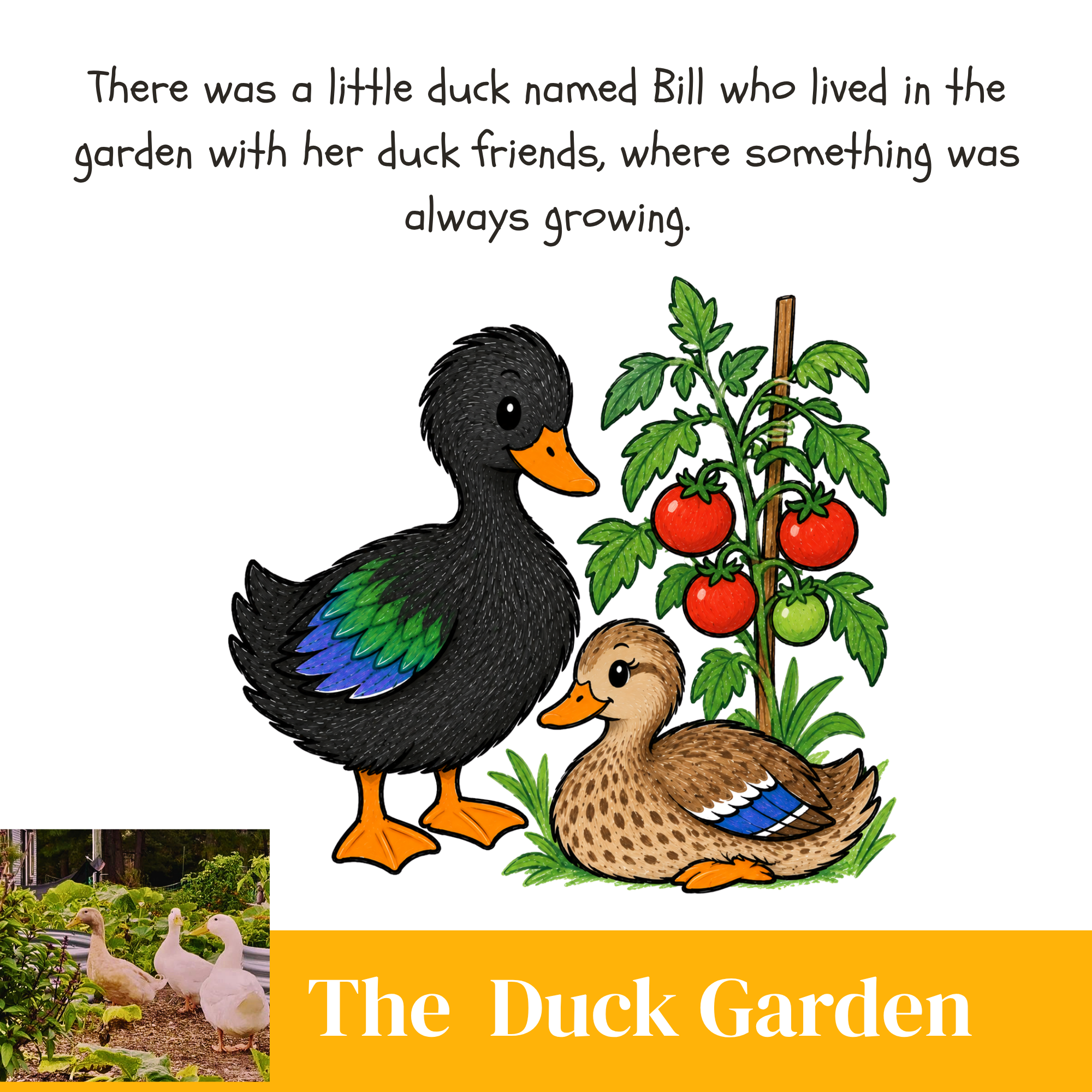
The Ducks are in the Garden
Growing food, tending the earth, and making room for every body—with a little help from the ducks.
In the garden, today's leftovers might be tomorrow's soil.
The ducks have a very simple philosophy about leftovers: if it's edible, it isn't a leftover. This is one of the many areas where the Farm Moms and the Duck Garden crew generally agree. Around Rainbow Connection Farm, we try to find another use for things before deciding they're waste. In the garden, that often means compost.
THIS WEEK IN THE GARDEN
Fall cleanup has started in the Duck Garden. Summer plants are getting tired, leaves are beginning to appear, and there are stems, vines, weeds, and other plant material that need somewhere to go. It would be easy to gather everything into bags and haul it away, but much of what looks like the end of this year's garden can actually help us grow the next one.
Composting is basically decomposition with a plan. Plant material naturally breaks down over time. When we gather appropriate materials together and give all those tiny decomposers the right conditions, they do what nature was already going to do. Eventually, yesterday's plants become dark, crumbly organic material that can be returned to the soil.
The ducks aren't particularly impressed by this process. They are more interested in whether anything entering the compost pile should have been offered to them first.
This is why all compostable kitchen scraps must first pass Duck Garden inspection.
WHAT WE'RE GROWING
This week, we're growing something you can't put in a salad: soil.
Technically, finished compost isn't soil by itself. It's decomposed organic material that we can add to our garden soil. That organic matter can help improve soil structure, support the organisms living underground, and help the soil hold moisture.
That's especially important to us because we're trying to build a garden that gets healthier over time instead of simply taking from the ground every growing season.
Some of our garden plants feed us. Some feed the animals. Some feed pollinators. And eventually, some of those plants die and go right back into feeding the garden.
A dead sunflower doesn't necessarily mean the sunflower has stopped being useful.
Its job may have just changed.
THE DUCK TEST
Can ducks eat compost? That is not the goal.
Will ducks investigate compost? Absolutely.
Should everything that can technically decompose go into a home compost pile? Definitely not.
Our ducks can enjoy appropriate fresh vegetables and garden treats, but compost isn't supposed to become a pile of forgotten duck snacks. We also have to be thoughtful about what goes into it. Healthy plant material, leaves, certain kitchen scraps, and other appropriate organic materials can become useful additions. Diseased plants, invasive weeds that have gone to seed, and materials that could introduce unwanted problems into the garden may need a different destination.
And because we share our farm with animals, we think carefully about what they can reach. "Natural" doesn't automatically mean "safe," and "compostable" doesn't automatically mean "feed it to a duck."
The ducks disagree with this policy.
The policy remains in effect.
GROW THIS AT HOME
Composting doesn't have to begin with an expensive bin or a complicated system. At its simplest, successful composting is about balancing materials that are higher in nitrogen—often called "greens"—with carbon-rich "browns."
Fresh plant trimmings and many fruit and vegetable scraps are examples of greens. Dry leaves, small amounts of shredded plain paper or cardboard, and dried plant material can provide browns. Add moisture and oxygen, and microorganisms begin doing most of the work for you.
One of the easiest things you can do this fall is save your leaves. Instead of treating every fallen leaf like trash, consider using leaves as mulch, adding them to compost, or keeping some to mix with greener material later.
A bag of leaves isn't necessarily yard waste.
It might be next year's garden.
WHY WE GROW THIS WAY
A farm produces an astonishing amount of stuff. There are feed bags, cardboard boxes, garden scraps, animal bedding, manure, fallen leaves, weeds, branches, and leftovers from 35 animals and the humans attempting to keep up with them.
We can't reuse everything, and not everything belongs in compost. But we can get into the habit of asking one question before something becomes trash: Can this have another job?
Cardboard might suppress weeds before eventually breaking down. Leaves can protect soil or become compost. Garden trimmings can decompose. Appropriate vegetable scraps might become animal treats before anything remaining heads toward compost.
That way of thinking changes a garden. Instead of seeing a straight line—buy it, use it, throw it away—we begin seeing circles.
The garden grows the plant. The plant feeds someone. What's left breaks down. That organic matter helps the soil. The soil grows another plant.
Nature is very good at recycling.
We're mostly trying to stop getting in its way.
FROM THE DUCKS
The Duck Garden crew has reviewed the composting operation. Ruth Stout and Irie would like vegetable scraps redirected to their department before any composting decisions are finalized. Betty Boop and Irene support this proposal. Othello has declined to comment because he is busy staying close to Bill.
Bill would like everyone to know that compost piles don't need to be climbed to be properly supervised.
The Farm Moms agree with Bill.
This is a rare moment of unanimous farm policy.
BILL'S DISABILITY MOMENT
Sometimes we talk about accessibility as though the goal is to help disabled people do everything exactly the way nondisabled people do it.
Bill reminds us that isn't always the point.
If the other ducks can climb over something and Bill can't, our first question doesn't have to be, "How do we teach Bill to climb over it?" A better question might be, "Does Bill actually need to climb over it?"
Maybe there is another path.
That distinction matters far beyond a duck garden. We often decide there is one "normal" way to complete a task, enter a building, communicate, learn, work, participate, or move through the world. Then we measure everyone according to how closely they can imitate that method.
Accessibility gives us permission to question the method instead.
A ramp and a staircase can lead to the same door. Sitting and standing can accomplish the same task. Written words and spoken words can communicate the same idea. Taking longer doesn't mean accomplishing less.
Different isn't automatically deficient.
Bill doesn't need to navigate the garden exactly like Othello, Betty Boop, Irene, Ruth Stout, or Irie. She needs a garden she can navigate as Bill.
The garden belongs to Bill, too.
