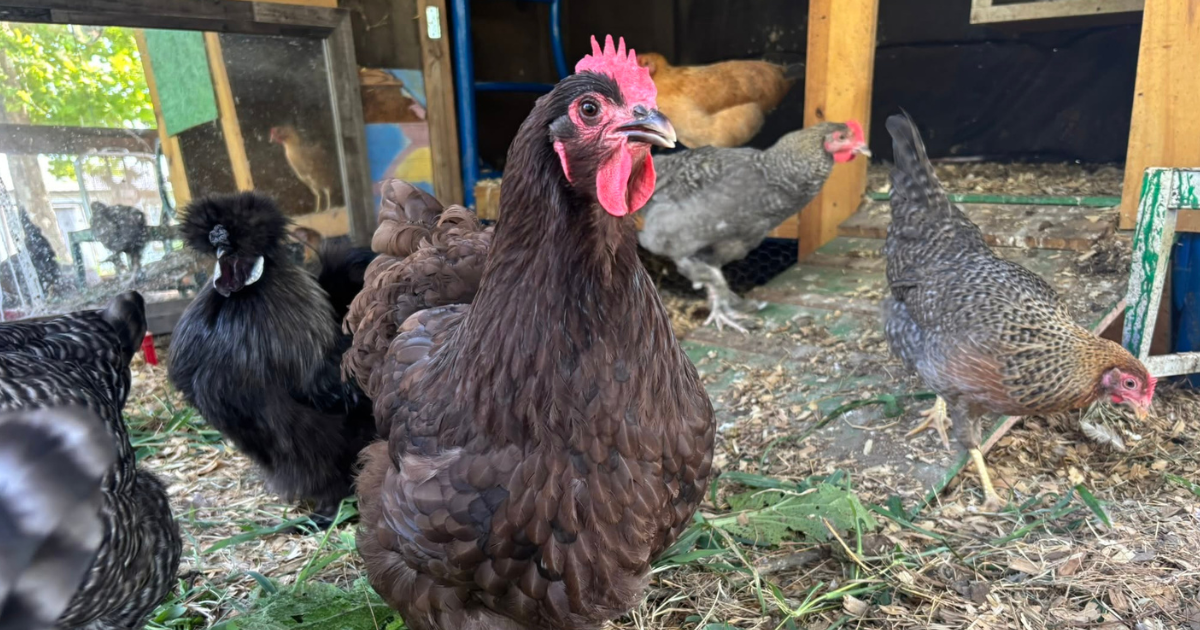
COOP OPERATIONS: WHY THE FENCE ALWAYS WINS
As told by the hens of Rainbow Connection Farm
It's 5:47 in the morning, we haven't even finished breakfast, and Donna the Buffalo is already lecturing everyone about fence posts. Again.
Look, we didn't ask to become fencing experts. We just live behind one. But when a raccoon tears through your actual wall at 4 a.m., you develop opinions fast. So gather round the coop, settle onto a roost, because this week we're telling you everything we know about fences — which, it turns out, is a lot.
Cooperation Gets the Job Done
Here's something we've picked up from two years of watching the Farm Moms: a farm runs on jobs that happen once a year, jobs that happen when something breaks, and jobs that happen literally every single day. Fencing, we regret to inform you, is all three. At once. Forever.
Because on this farm, the fence isn't decoration. It's the only thing standing between "everybody is exactly where they're supposed to be" and "why is Piglet in the garden with the ducks." We've seen it happen. It is chaos. Nobody's eggs are safe.
This Week's Farm Job
Here's a number that made even us pause mid-peck: a single acre — if it were a perfectly tidy square, which nothing on a real farm ever is — needs roughly 835 feet of fence to wrap all the way around it. Now stretch that across an actual farm.
Rainbow Connection Farm doesn't even have one pasture. It has two — a 3-acre pasture and a 2-acre pasture, fenced separately from each other. Add those perimeters together and you're looking at somewhere around 2,600 feet of fence just for the horses. Just for them. We haven't even gotten to us yet.
And it isn't all the same fence, either. The pastures are wire fence. Our coop and the duck garden are wrapped in hardware cloth — that fine mesh that's supposed to keep small predators from squeezing through gaps a regular wire fence would let right past. The kitchen garden is different from all of it: electric fence with plastic cloth, because the horses kept nibbling everything in it until an electric fence became the only thing that got the message across. And the pig area is braided wire, which is its own entire category of "we mean business."
Five enclosures. Four different fencing setups. Five different ways for something to go wrong.
And if you want to know which one actually keeps the Farm Moms up at night, it's not us. It's the pigs.
Pigs are smart. Genuinely, frustratingly smart, and we say that with the full respect of animals who have watched them work. Pigs don't just lean on a weak fence and hope. They investigate it. They test it strategically. And if there is any way at all to move it, they will find that way, on their own schedule, usually while everyone's back is turned. A fence that would hold a duck without a second thought doesn't stand a chance against a bored, curious pig with time on its hooves. That's exactly why the pig fence is braided wire instead of standard wire fencing — it takes something stronger just to stay a fence.
Then the weather shows up to make things worse. Strong winds and heavy rain do not care how solid a post looked back in July. Softened ground loosens posts, gusts rock them back and forth, and a fence line that felt rock-solid last week can be leaning by the weekend.
Fence repair, as far as we're concerned, is one long ongoing negotiation with pigs, wind, rain, and the occasional determined hoof.
Weird and Interesting Facts (Learned the Hard Way)
Pigs are natural excavators, and our braided wire pig fence has to hold against digging from below and pushing from the side at the same time — pigs will always find whichever one is weaker.
Predator-proofing isn't just about height. A lot of predators dig under or squeeze through gaps most people wouldn't think twice about, which is exactly why our coop and the duck garden are wrapped in hardware cloth instead of standard wire fence.
The kitchen garden runs on electric fence, not because of predators, but because of horses. Turns out a determined horse will nibble a garden down to nothing given the chance — electric fence was the only thing that convinced them otherwise.
Even hardware cloth has a limit. Raccoons and other determined predators try our chicken fence more than you'd think, and a strong enough raccoon can actually tear the mesh open. We know this personally. We'll get to that.
Wet, wind-loosened soil is one of the sneakiest threats to a fence post — it can look perfectly upright and still be barely holding on underground.
Most fence failures aren't dramatic. They're a slow list nobody notices — a post leaning three degrees for six months before it finally gives up.
A Note From the Hens
We weren't going to bring this up. But the Farm Moms insisted it belongs in this week's post, and honestly, we agree it's important.
Early one morning, before the rooster had even started his usual routine, a raccoon tore right through our hardware cloth. We are chickens. We do not love confrontation. We would like that noted for the record.
But Annie does love confrontation, in the best possible way. She heard something was wrong before any of us fully registered it, and she made sure the whole house knew it too. The Farm Moms were out the door and at the coop fast enough that the raccoon never got near us — it got chased off before it could finish whatever it thought it was going to do.
We're fine. Truly. But "fine" wasn't good enough for Kelley and Britt. The fence got reinforced right where it failed, and perimeter lights went up around the coop as an extra layer of protection — because a determined raccoon in the dark is a very different problem than a determined raccoon standing under a light it very much does not want to be under.
We'd still rather not test that theory again. But if we do, we're fairly confident Annie will let everyone know first.
How the Farm Moms Make It Work
Fencing is one of those jobs that never really finishes — it just gets checked, again, on a loop, forever, without anyone really calling it a separate chore anymore. Kelley and Britt split it the way they split everything else on this farm: whoever's out doing morning chores or evening feeding is also doing a fence check, almost without thinking about it. See a lean, flag it. See a gap, patch it before it becomes an escape route instead of after — and the pig fence gets the closest attention of all, because a bored pig does not wait politely for the next inspection.
The long-term dream is a full perimeter fence in galvanized wire and wood, and they're slowly working toward it — replacing sections of the existing wire fence bit by bit, right alongside the regular maintenance. Galvanized fencing holds up better against predators, and it would solve a problem the current fence can't: keeping deer out of the back pasture, where they've found a safe place to slip in unnoticed. It's not a quick project. It's a "one section at a time, keep the rest patched in the meantime" kind of project — which, honestly, is a pretty accurate description of most fence work around here.
It's not glamorous. Nobody posts a highlight reel of a fence simply staying where it's supposed to be. But behind every one of us who's safely where we belong is a fence somebody walked, tested, and fixed before it ever became a problem.
We'll be here. Roosting, watching, and reporting back if anything moves that shouldn't.